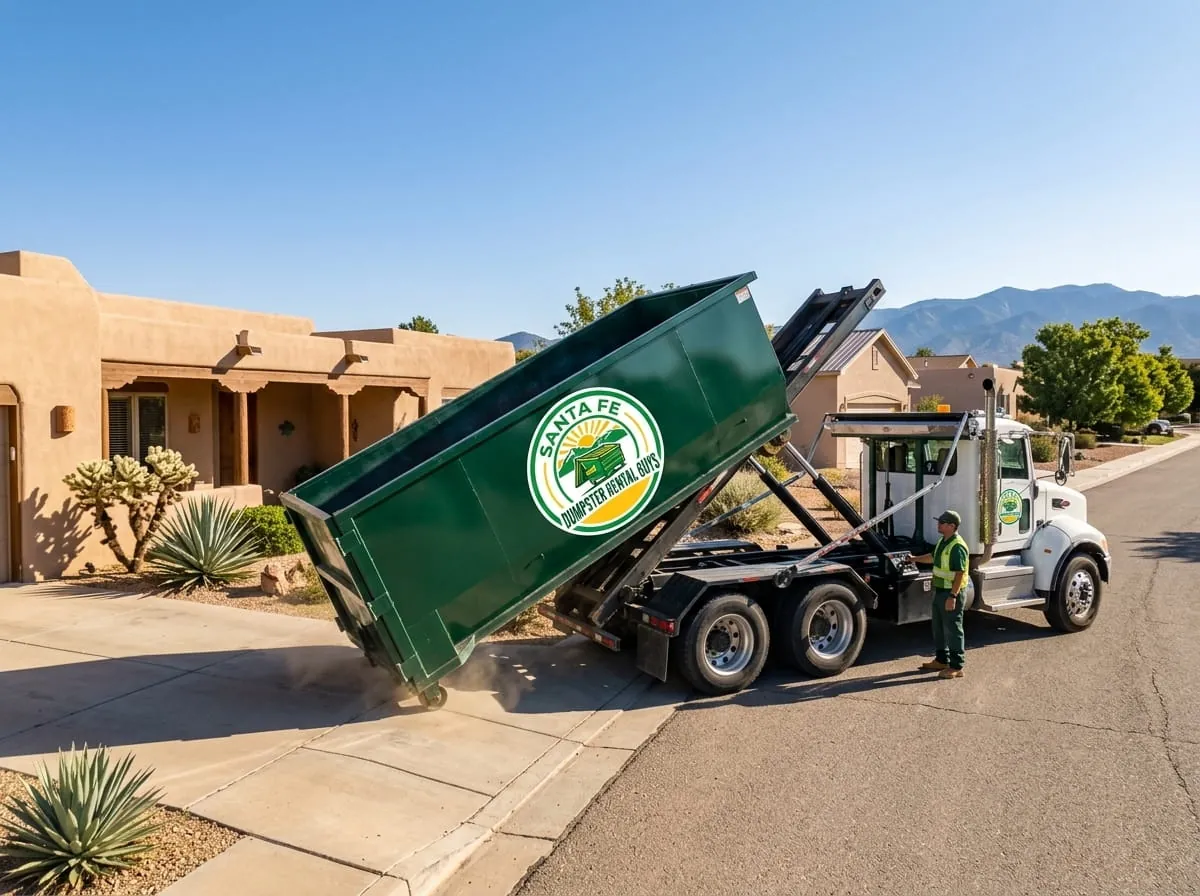
If you're planning a home cleanout, a remodel, or a landscaping overhaul in Santa Fe, one question tends to come up before the roll-off ever arrives: do you need a permit to put a dumpster on your property? The short answer is that it depends almost entirely on where the container will sit. Place it on your own driveway or private property and you almost never need a permit. Place it in the public street or right-of-way and the City of Santa Fe or Santa Fe County will usually want an encroachment or right-of-way permit first. Add in Santa Fe's historic districts, narrow adobe-lined streets, and monsoon season, and the placement decision becomes genuinely local. This guide walks through the practical rules so you can plan with confidence.
At Santa Fe Dumpster Rental Guys, we're a local, licensed roll-off company, and we help customers think through placement every day. Nothing here is legal advice, and rules do change, so always confirm the specifics with the City of Santa Fe or Santa Fe County before your delivery date. When in doubt, call us at (505) 557-2849 and we'll talk it through.
The Simple Rule: Private Property Usually Means No Permit
Here's the good news for most homeowners. If your roll-off dumpster sits entirely on your own private property — a driveway, a parking pad, a side yard, or a gravel area behind an adobe wall — you generally do not need a permit from the city or county. You own or control that ground, so the container isn't obstructing anything public. This covers the large majority of residential jobs we handle across Santa Fe.
The vast majority of our residential dumpster rentals go straight onto a driveway, and that's the smoothest path for everyone. To keep a driveway placement clean and permit-free:
- Confirm the container fits fully on your property. Even a few feet hanging into the street can change the answer. Our 10-yard and 15-yard bins fit most Santa Fe driveways; the 20 and 30 need more room.
- Watch your setbacks from adobe and coyote-fence walls. Many older Santa Fe lots have walls close to the drive. We need swing clearance for the roll-off truck and the rear door.
- Protect the surface. We can set boards under the bin to guard pavers, stamped concrete, or a soft asphalt drive that's seen a few high-desert summers.
- Mind overhead lines and low portales. A roll-off truck needs vertical clearance to raise and lower the container.
If your driveway works, you've likely sidestepped the permit question entirely. If it doesn't, keep reading.
When You DO Need a Permit: Streets and the Public Right-of-Way
The moment a dumpster occupies the public street, a travel lane, an on-street parking area, or the right-of-way in front of your home, permitting comes into play. The public right-of-way typically includes the paved roadway plus a strip of land beyond the curb or pavement edge — often extending across what looks like the front of your yard. Placing a container there is considered a temporary encroachment or obstruction, and Santa Fe wants it documented and, where needed, marked for safety.
You'll generally need a right-of-way or encroachment permit when:
- Your lot has no usable driveway and the only spot for the bin is the street.
- The container will block or narrow a public travel lane, even partially.
- You're placing it in a metered or signed on-street parking zone.
- The job is on a narrow historic street where any obstruction affects traffic flow (more on that below).
Street placements can also come with conditions — reflective markers or cones, a required clear width for emergency vehicles, and limits on how many days the container may stay. Because Santa Fe's older neighborhoods have some genuinely tight streets, the city takes lane obstructions seriously.
How the Santa Fe Permit Process Generally Works
Every jurisdiction runs its own counter, and details shift over time, so treat this as a general roadmap rather than a checklist. Whether your address falls inside Santa Fe city limits or in unincorporated Santa Fe County determines who issues the permit.
Inside the City of Santa Fe
For an address within the city, right-of-way and encroachment permits are handled through the city's public works and permitting functions. In broad terms, you can expect to:
- Identify the exact placement location and the number of days the container will be out.
- Provide the property address and container size so the city can assess the impact on the roadway.
- Agree to any traffic-control or safety conditions, such as reflective markers overnight.
- Pay the applicable permit fee and observe the approved duration.
In Santa Fe County
If you're outside city limits — many properties around Santa Fe are — the county handles right-of-way encroachments on county-maintained roads through its own public works process. State-maintained roads add another layer. Rural lots usually have plenty of private space, so county residents often avoid the street entirely, but confirm before assuming.
Timelines vary, so build in a buffer. We're happy to help you gather the placement details a permit application asks for; you can always reach our team through our contact page or by phone.
Historic Districts, the Plaza, and Canyon Road
This is where Santa Fe stands apart from almost anywhere else, and it deserves real attention. Much of the downtown core, the Eastside, the area around the Plaza, and the Canyon Road corridor sit within designated historic districts governed by the Historic Districts Review Board. These districts protect the city's distinctive Pueblo and Territorial character, and exterior work in them can trigger additional review.
A dumpster itself is temporary and typically isn't the object of historic design review the way a wall, window, or facade change would be. But historic zones still shape your placement in practical ways:
- Streets are exceptionally narrow. Around the Plaza and along Canyon Road, lanes are tight and parking is scarce. A street placement that would be routine elsewhere may be tough to approve here, so a private-property spot is strongly preferred.
- Adobe walls and setbacks limit staging. Historic lots often have walls right at the property line, leaving little room to maneuver a roll-off. Access planning matters.
- Anything tied to exterior renovation may involve review. If your dumpster is part of a larger project touching a building's exterior in a historic district, that project may need Historic Districts Review Board sign-off — separate from the dumpster question. Confirm early.
- Pedestrian and tourist traffic is heavy. Near the Plaza and Canyon Road galleries, foot traffic is constant, which raises the bar for safe, unobtrusive placement.
If your project is in one of these areas, call us first. We know these blocks, and we'll help you find a spot that keeps the job moving without running into avoidable trouble.
HOA Rules and Monsoon-Season Placement
Two more local factors round out the picture. First, homeowners associations. Plenty of Santa Fe subdivisions — especially in areas like Las Campanas, Rancho Viejo, and the newer developments — have HOA covenants that regulate dumpsters even on your own driveway. HOAs may limit how long a container can stay, require it out of street view, or ask for advance notice. An HOA rule is separate from a city or county permit, and it's easy to overlook. Check your covenants before you book.
Second, Santa Fe's monsoon season. From roughly July into September, sudden afternoon downpours send water racing along streets, gutters, and arroyos. That affects dumpster placement more than people expect:
- Don't block drainage. Avoid setting a container where it dams a gutter line, a curb cut, or the natural runoff path across your lot.
- Mind soft ground. A loaded bin on saturated dirt or gravel can sink or shift; a firm driveway is safer in storm season.
- Keep debris contained. Heavy rain can wash loose lightweight debris out of an open bin, so we recommend not overfilling above the rim.
These are small adjustments, but they save headaches when a monsoon cell rolls through.
Let Santa Fe Dumpster Rental Guys Help You Plan Placement
For most Santa Fe homeowners, the permit question has a reassuringly simple answer: put the dumpster on your driveway or private property and you almost certainly won't need one. It's when the container has to sit in the street, the right-of-way, or a tight historic block that a City of Santa Fe or Santa Fe County permit — and sometimes an HOA nod — enters the picture. Always confirm the current rules with the city or county for your exact address, because regulations do change.
We do this every day and we're glad to advise on placement, sizing, and whether your spot is likely to need a permit before you commit. We offer flat-rate, same-day roll-off rental in 10, 15, 20, and 30-yard sizes across Santa Fe and Santa Fe County. Ready to book or just have a question? Call Santa Fe Dumpster Rental Guys at (505) 557-2849 and we'll help you get it right the first time.
Founder, Santa Fe Dumpster Rental Guys — sharing straight advice from more than 15 years of local hauling experience.