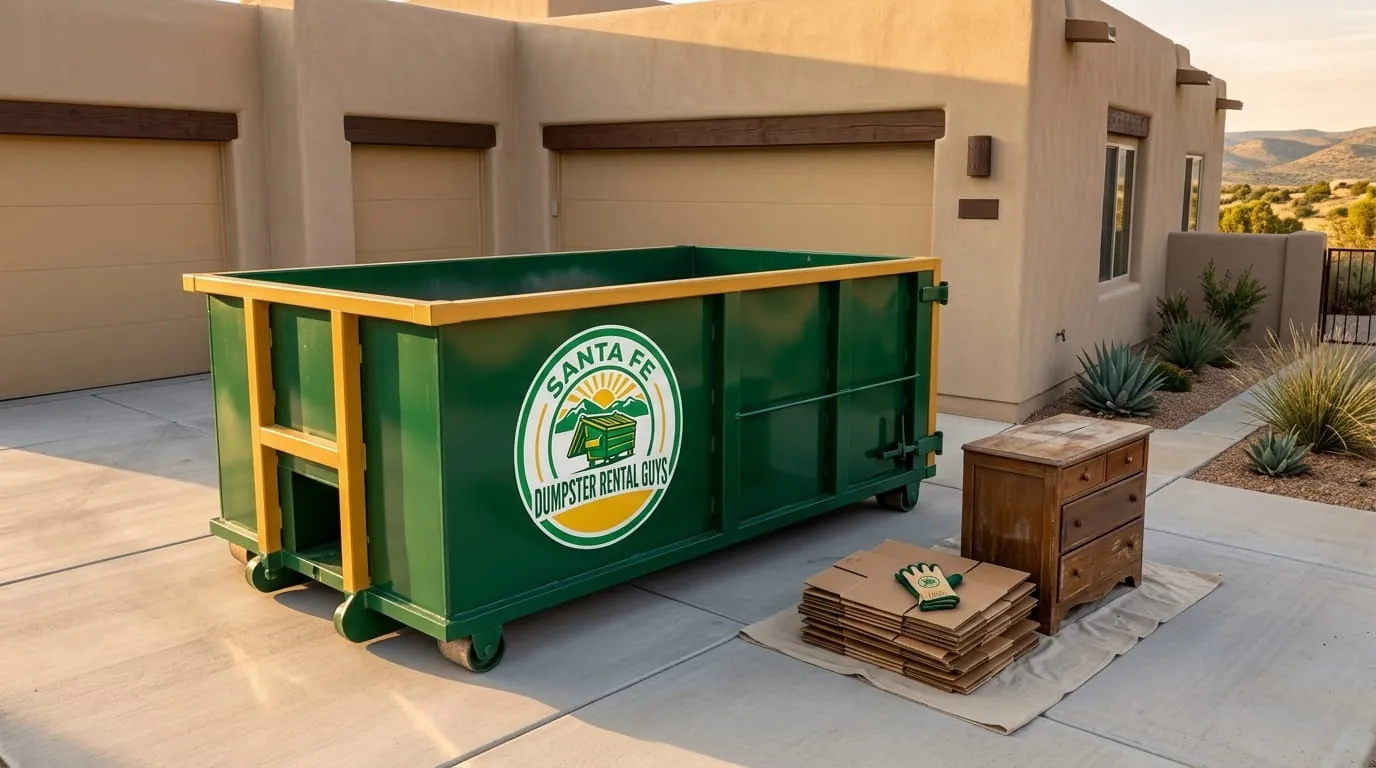
A roll-off dumpster is one of the most useful things you can park in your yard during a renovation, a garage cleanout, a roof tear-off, or a xeriscape overhaul. It is also several thousand pounds of steel that gets dragged off the back of a truck and set down on whatever surface is beneath it. In Santa Fe, that surface might be a hand-laid flagstone portale, a stamped concrete apron, a soft dirt drive winding up into the foothills, or a narrow historic-district lane hemmed in by adobe walls. Each one calls for a slightly different approach. The good news is that protecting your driveway is mostly a matter of planning the placement and putting the right material under the bin before it lands. Here is how it works, and what a careful company does automatically.
How Roll-Off Delivery Actually Works
Understanding the mechanics of delivery makes it obvious why placement matters so much. A roll-off truck backs up to your chosen spot, tilts its bed, and lets the dumpster slide down on a set of steel rollers and wheels at the rear. As the container comes off, the back rails and wheels bear the entire weight along a narrow contact line before the bin settles flat. Pickup reverses the process: a cable winches the loaded container, now far heavier, back up the tilted bed.
Two moments create nearly all driveway damage. The first is that drag and pivot as the bin lands and is nudged into final position, where wheels and rails can gouge or scratch a finished surface. The second is the concentrated point load where the rear wheels sit for the duration of the rental, which can crack a slab or sink into soft ground. Everything below is about controlling those two moments.
Why Placement Is Half the Battle
The single best way to protect a surface is to not set the dumpster on a vulnerable one in the first place. Before delivery day, walk your property and look for the least precious spot that the truck can still reach. A gravel pad, a wide dirt shoulder, or an unfinished side yard is almost always a better host than your decorative front apron.
In town, placement is often dictated by what you do not have room for. Many historic-district drives are narrow, walled by adobe or bordered by coyote fencing, with a tight turning radius that leaves the driver only one workable angle. On foothill and rural properties the opposite problem appears: plenty of room, but the only firm approach runs straight across a soft dirt drive. Think about a few things as you scout:
- Overhead clearance — the truck bed rises high during delivery, so avoid low portale roofs, canale overhangs, and cottonwood or piñon limbs.
- Slope — a level spot keeps the load from creeping and keeps rainwater from pooling under the container.
- Access width — measure gate openings and the pinch points between an adobe wall and a parked car before you commit.
- Distance to the work — closer is more convenient, but not if it means landing the bin on your nicest surface.
When you call to book, describe your driveway honestly. A dispatcher who knows there is stamped concrete or flagstone in play can send the right protection and brief the driver in advance. You can share these details when you reach out to schedule.
Boards, Plywood, and Why They Work
The workhorse of driveway protection is simple: lay planks or plywood down first, then set the dumpster on top of them. The physics is straightforward. A board spreads that concentrated wheel load across a much larger area, so the pressure on any one point of your surface drops dramatically. It also gives the wheels and rails a sacrificial layer to scratch instead of your finish.
A few practical guidelines make the difference between real protection and a token gesture:
- Use thick, solid boards — nominal two-by lumber or three-quarter-inch or thicker plywood. Thin panels flex and can snap under a loaded bin.
- Place material under both the rear wheels and the front rails, the two points that carry the most weight.
- Run the boards the full length of the container's contact points, not just a small square in the middle.
- On a slope, make sure the boards sit flat and do not create a rocking point.
Reputable operators carry this material on the truck and lay it as part of the drop. If you are renting from a company that does not, a stack of your own plywood under the wheels is cheap insurance. For a plain-language overview of container sizes and how they are delivered, our roll-off dumpster rental page walks through the basics.
Protecting Pavers, Stamped Concrete, Brick, and Flagstone
Finished decorative surfaces are the ones homeowners worry about most, and rightly so. These are the details that give Santa Fe homes their character, and they are expensive to repair.
Pavers and brick
Interlocking pavers and brick can shift, rotate, or crack under a point load, and a dragging wheel can chip an edge or scuff the surface. Individual units can also sink unevenly into the sand bedding beneath them. A continuous plywood platform is essential here so the weight bridges across many units at once rather than pressing on a few.
Stamped and colored concrete
Stamped concrete has a decorative surface layer and a sealer that scratches easily. A steel wheel dragged across it leaves marks that are hard to undo, and a heavy bin can crack a slab that was never engineered for that kind of concentrated weight. Boards under every contact point are non-negotiable on stamped or colored concrete.
Flagstone portales and patios
Flagstone set in mortar or sand is common on Santa Fe portales and entry patios. It is beautiful and it is brittle. Individual stones can crack under a wheel and the mortar joints can fracture. If a flagstone area is the only option, heavy cribbing and full-length boards are the minimum, and honestly, it is usually better to find an alternate spot entirely.
Dirt, Gravel, and Soft Ground After the Monsoon
Plenty of Santa Fe properties, especially out toward the foothills and in the rural county, have dirt or gravel driveways rather than paved ones. These will not scratch, but they bring their own challenge: the container can sink. A dumpster's wheels concentrate thousands of pounds onto a small footprint, and dry ground that seems perfectly solid can give way once weight sits on it for days.
The monsoon season makes this dramatically worse. A July or August downpour turns packed caliche and dirt into mud, and a bin that was stable on Monday can settle, tilt, or rut deep tracks by Friday. When the truck comes back for a heavy, loaded container on soft ground, it can leave gouges that take a grader to fix. To keep a dirt or gravel drive intact:
- Choose the highest, best-draining spot so water sheds away from the container.
- Put down a wide base of boards or thick plywood to spread the load and stop the wheels from sinking.
- If heavy rain is forecast, mention it when booking so delivery and pickup can be timed around the worst of it.
- Avoid low areas where runoff collects and where a coyote-fence line or xeriscape berm might trap standing water.
Weight matters here more than anywhere. A 30-yard bin full of roofing or dirt is far heavier than a 10-yard of household clutter, so match the container to the job and to the ground it will sit on. Our residential dumpster rental options cover the 10, 15, 20, and 30-yard sizes and where each one makes sense.
What a Good Dumpster Company Does Automatically
You should not have to be a driveway-protection expert to rent a dumpster safely. A careful, local company handles most of this for you. When we deliver in Santa Fe, we ask about your surface before the truck rolls, we bring boards and lay them under the wheels and rails as a standard part of the drop, and we position the container so the driver has a clean angle that avoids adobe walls, low portales, and tight coyote-fence gates. We also think about weight, drainage, and monsoon timing so a loaded bin does not rut a soft drive on the way out.
Flat-rate, same-day, and call-only means you talk to a real person who knows Santa Fe driveways rather than clicking through a form that never asks about your flagstone. That conversation is where good placement decisions get made.
Protect your driveway and your project at the same time. Call Santa Fe Dumpster Rental Guys at (505) 557-2849 for straight answers, a flat rate, and a careful drop on the right spot the first time.
Founder, Santa Fe Dumpster Rental Guys — sharing straight advice from more than 15 years of local hauling experience.